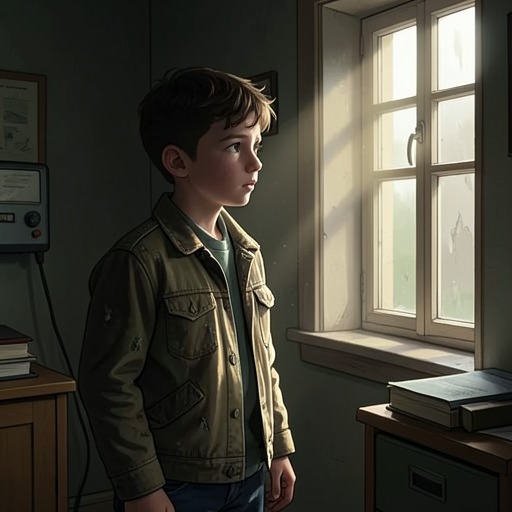
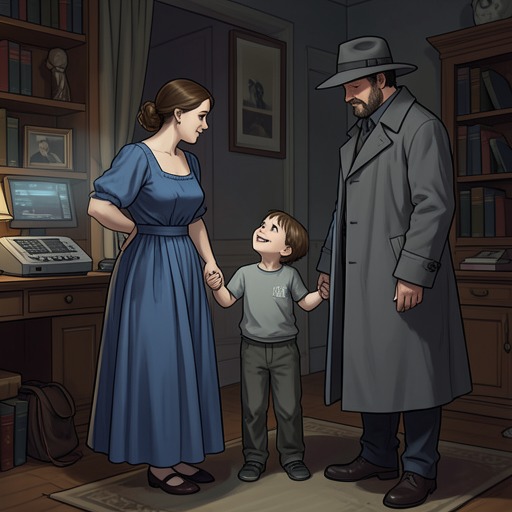
Josie and Rick
Klara and the SunJosie and Rick are childhood companions whose affection survives illness, arguments, and unequal access to education, but their relationship does not culminate in a common future. Their recurring plan to share a life gives their bond direction; as Josie’s illness and Rick’s unlifted status make their paths increasingly different, reconciliation restores their tenderness without resolving that separation.
Childhood Bond and Shared Plan
Josie wants Rick included when her mother proposes a gathering with her friends. She insists that the others are not really her friends and says that, if she must host the meeting, she wants Rick there. Her mother agrees and stresses that Rick is a good person and their neighbor. The exchange establishes how naturally Josie looks to Rick for companionship, even in a social setting where she feels out of place.
Their plan to share a future becomes a private standard against which they measure their present. Rick fears that Josie’s new social circle will change her, and says she is pressing to keep their plan alive after having forgotten it for a time. Klara interprets his fear more generously: the other children may behave roughly because they too fear loneliness, and Josie may share that fear. The plan is therefore not simply a promise of romance; it also represents continuity and refuge from the social pressures surrounding them.
Unequal Prospects and Conflict
The possibility of a future together is shaped by the society’s distinction between lifted and unlifted children. Josie challenges Rick to do more than talk about their plan, arguing that each passing day and new complication makes it harder to imagine how it could work if she has access to society and he does not. Rick points to the very small number of unlifted students admitted to Atlas Brookings, while Josie insists that he is more capable than the other unlifted applicants and should try. Their disagreement joins a practical question about education to an emotional one: whether Rick will act to make a shared future possible.
Josie also accuses Rick’s mother of having kept him from being lifted because she wanted him to remain with her. Rick rejects the relevance of the society’s rules, but Josie says those rules obstruct their plan. Her criticism makes the future they imagined seem dependent on forces neither of them controls, while also placing pressure on Rick to take responsibility for his own prospects.
Their closeness does not spare them from misunderstandings about intimacy. Rick tells Klara that Josie repeatedly makes him feel trapped: she criticizes him for paying too much attention to girls on his device, then treats his lack of response as unnatural; she also raises the possibility that their long familiarity might make a sexual relationship difficult. He says that whatever he does seems wrong and objects to Josie’s attacks on his mother. The account reveals a strain beneath their shared plan: they are trying to define an adult relationship while still carrying the habits and expectations of childhood.
Illness and Reconciliation
Josie’s worsening illness changes the urgency of their disagreements. Rick tells Klara that their plan will mean nothing if Josie does not recover soon and asks how ill she seems. His question shows how the imagined future is inseparable from concern for her immediate survival; as her condition becomes uncertain, long-term plans lose their stability.
After a period of estrangement, Rick visits Josie at home. The next morning she hurries from her bed when he arrives, then deliberately adopts a blank expression and pretends not to know who he is. Rick answers with a cautious, playful suggestion that they might be friends again. The teasing allows them to approach reconciliation without pretending that their earlier hurt never happened.
They acknowledge that they are no longer angry. Josie apologizes for what she said about Rick’s mother and for making him worry by being sick so often. Rick steps closer and puts an arm around her, then the other; Josie lets him hold her, though she does not return the gesture in the same way she embraces her mother at a farewell. Their exchange restores warmth while retaining a quiet difference in how they express affection.
Different Futures and Lasting Significance
Rick’s prospects remain shaped by the limits placed on unlifted students. Josie’s mother explains that Atlas Brookings is the only proper college still taking a small number of them, that competition is severe, and that Rick lacks access to suitable tutors: members of TWE are forbidden to tutor unlifted children, while other tutors demand fees his family cannot afford. She sees Klara’s arrival next door as a possible source of help, but Rick objects to taking the discussion further. These constraints make the couple’s shared plan dependent not only on their feelings but also on scarce educational opportunities and family circumstances.
Rick’s ability nonetheless receives recognition. At a family gathering, Josie’s father praises Rick’s drone work and says that genuine ability should be noticed whether or not its maker was lifted. Rick credits the father’s earlier encouragement and instruction with helping form the foundations of his work. The moment offers evidence of Rick’s talent and of support beyond Josie, but it does not erase the institutional barriers that make his future uncertain.
Later, Klara observes that Rick and Josie still show kindness to each other while preparing for very different futures. Rick recalls Klara’s earlier question about whether his love for Josie was genuine and everlasting, and recognizes that her present anxiety concerns precisely the distance opening between them. Their relationship thus ends in neither simple estrangement nor fulfillment of the old plan: reconciliation preserves affection, while their diverging prospects remain real. The contrast gives the bond its particular poignancy—their kindness endures, but kindness alone cannot make their lives converge.